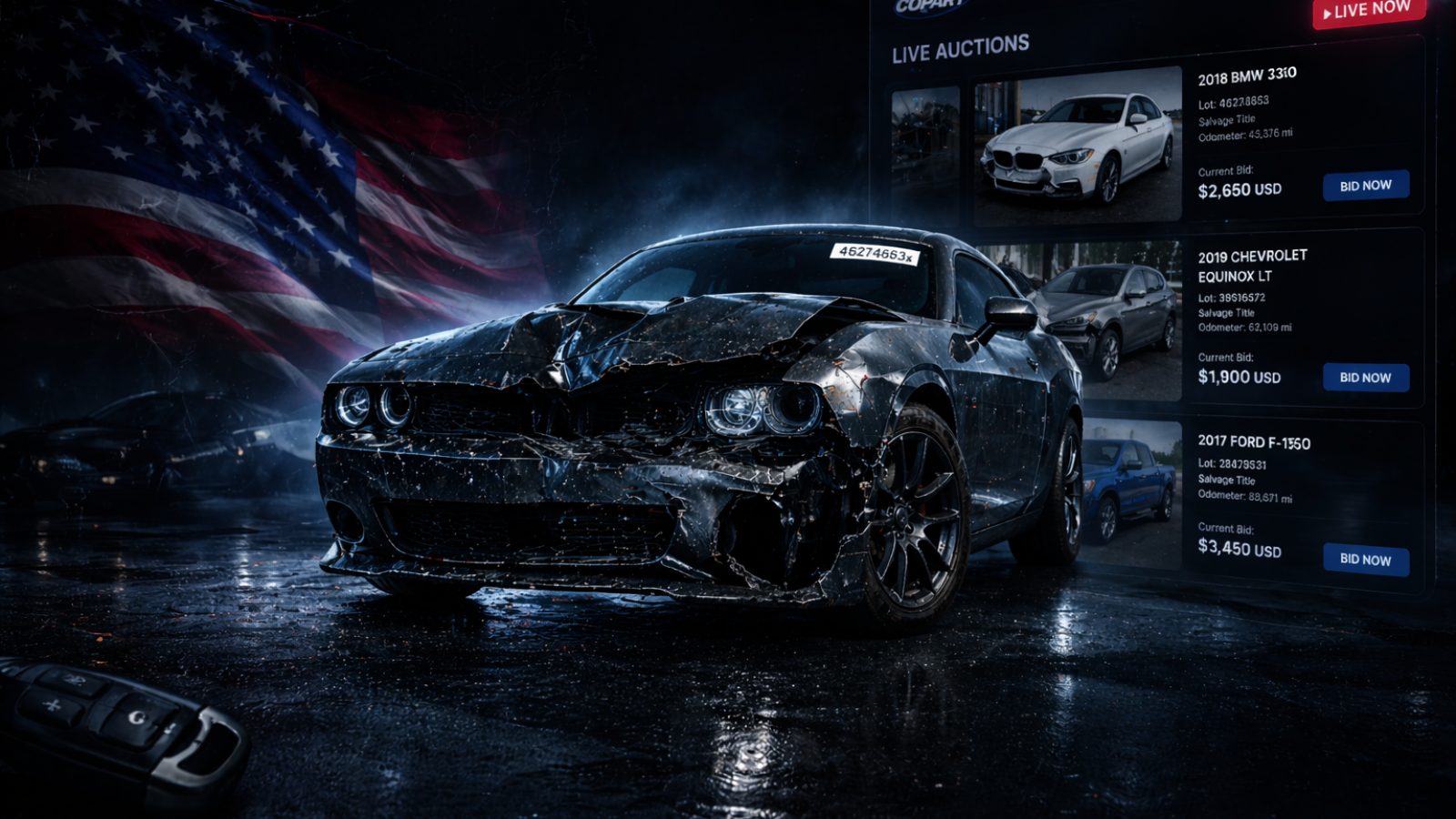
When buying a used car - especially one imported from the US - two things are critical: the auction history and the Title type (vehicle ownership document). One tells you the car's real condition and what was paid for it; the other decides whether you can even register it in your country. In this article we compare Copart, IAAI, BidFax and BidCheck.info, and explain the differences between clean title, salvage, flood and junk title.
US Title types - what you need to know before buying
In the United States, every vehicle is assigned a Title - a document defining its legal and technical status. The type of title determines the car's value, whether it can be repaired, and whether it can be registered in Europe.
Clean Title
Vehicles with minor damage or no accident history that have not been entered into the system by state authorities or insurers. These cars can be registered in Europe without complications.
Collision Damage Salvage Title
A damaged vehicle - reported by state authorities or insurers after a collision, theft, vandalism or hail damage. Buying a vehicle with the wrong Title may make it impossible to register in Europe.
Water / Flood Damage Salvage Title
Issued when a vehicle has been damaged by water - flood, hurricane, a flooded parking lot. These cars are particularly risky because of hidden damage to electronics, upholstery and corrosion.
Fire Damage Salvage Title
Issued when a vehicle has been damaged by fire - whether by accident, arson, or engine failure.
Hail Damage Salvage Title
Issued when hail has caused body dents, cracked windows or sunroof damage. The damage may be purely cosmetic, but still results in a salvage title.
Theft-Recovered Salvage Title
Issued for vehicles recovered after being reported stolen and paid out by an insurer. These cars often have only minor damage or missing parts (wheels, stereo, trim).
Vandalism Salvage Title
Issued when a vehicle has suffered significant damage from intentional acts - graffiti, broken windows, structural damage.
Non-Repairable / Junk Title
This means the vehicle is beyond repair and cannot be returned to road use. Usually sold for parts or scrap - avoid this Title at all costs if you plan to drive the car.
Which Titles can be registered in Europe?
In practice the following are the easiest to register:
- Clean Title
- Salvage Title
- Salvage Rebuildable Title
- MV-907A (provided there is no lien entry)
In theory not every title is suitable for registration, but in practice it's common to do a so-called "flip" and re-issue most titles, or obtain an abstract. It's a widespread practice, but it does generate extra costs of several hundred dollars.
Titles to avoid
The following Title types tend to result in expensive complications or outright registration refusal:
- ACQ / ACQUISITION BILL OF SALE
- ARTIFICERS LIEN TRANSFER
- ABND / LIEN NC DLR ONLY DELAY
- BILL OF SALE, BV
- CLEAN TITLE - NO VIN
- CLEAN TITLE W/ UNSATIS LIEN
- CERTIFICATE OF DESTRUCTION
- CERT OF SALV BRANDED FLOOD
- DISMANTLER W/ UNSATISFIED LIEN
- EXPORT BILL OF SALE
- FOR JUNK, FLOOD, FLOOD SALVAGE, FLOOD TITLE, FLOOD SALVAGE VEHICLE TITLE
- FIRE DAMAGE
- FOR PARTS ONLY, PARTS ONLY W/ NY REASSIGNMENT
- IRREPARABLE, NON-REPAIRABLE, NON-REBUILDABLE
- MV907A, MV907A WAIV-272.1, MV907A W/ BRAND WAIVE, MV907A W/ NO PUBLIC VIN, MV907A W/ UNSATISFIED LIEN, MV907A W/ MD REASSIGNMENT
- MV37 P.O. DISM, MV35 NO TITLE-DISMANTLE/SCRAP, MV-51B / STMT OF OWNERSHIP, NY-MV-51
- REBUILDABLE KIT CAR, REBLT SALV W/ UNSATISFIED LIEN
- SALVAGE THEFT - NO PUBLIC VIN, SALVAGE TITLE DAMAGE WATER/FLOOD
- WATER, WATER/FLOOD
Why auction history matters
Before buying any used car - especially one that may have passed through a US auction - you need to know:
- Whether it was declared a total loss (salvage title)
- The type and extent of damage
- The final sale price
- Photos from the time of the auction
- Odometer readings over time
This information will tell you whether a car advertised as "accident-free" was actually wrecked and "refreshed" by dealers.
Option 1: Copart.com
What it offers: direct access to the largest US salvage auction.
Pros:
- The most authoritative source for vehicles listed on Copart
- Full photos and descriptions
- Ability to bid directly (with a dealer account)
Cons:
- Historical data requires a paid membership
- Limited to Copart listings only (no IAAI)
- No data for cars that never passed through Copart
- A significant share of listings come from private sellers
Cost: dealer membership $200+/year, report access varies.
Option 2: IAAI.com
What it offers: direct access to IAAI inventory and history.
Pros:
- The second-largest auction after Copart
- Comprehensive vehicle condition reports
- Verified sellers - around 90% of cars come from agencies and insurers (safer)
- Some data is free for registered users
Cons:
- Full historical access requires a dealer license
- Limited to IAAI only
- A more complex interface than Copart
Cost: similar to Copart - $200+/year for full access.
Option 3: BidFax
What it offers: a paid third-party aggregator of Copart and IAAI data.
Pros:
- Covers both Copart and IAAI in one place
- No dealer license required
- Historical data available
Cons:
- Pay per report ($5-$15 each)
- Some data may be outdated
- Subscription plans can be expensive
Cost: $5-$50 per report, $20-$100/month for subscriptions.
Option 4: Bid.cars / Dreambid and other broker services
What they offer: broker services with client access to reports.
Pros:
- Full service - they bid on your behalf
- Report access included for clients
- End-to-end handling from bidding to shipping
Cons:
- Broker commissions added to every transaction
- Reports usually only for cars you're actually considering
- Not a pure research tool
Option 5: BidCheck.info - the free alternative
What it offers: free access to Copart and IAAI auction history.
Pros:
- 100% free - no payment, no registration
- Covers both Copart and IAAI in one place
- Full photos, damage reports, final prices
- Search by VIN, make/model or by category
- Multilingual interface (EN, PL, DE, ES, UK)
- No dealer license required
Cons:
- You can't bid through the service - information only
- Database updates with some delay (not real-time)
Cost: free - forever.
Comparison table
| Service | Cost | Copart | IAAI | Dealer license |
|---|---|---|---|---|
| Copart.com | $200+/year | Yes | No | Required |
| IAAI.com | $200+/year | No | Yes | Required |
| BidFax | $5-$50/report | Yes | Yes | Not required |
| Bid.cars / Dreambid | % commission | Yes | Yes | Not required |
| BidCheck.info | Free | Yes | Yes | Not required |
Which one to choose?
- Just need to check a car's history: BidCheck.info - free, fast, no registration.
- Want to bid on cars: use AutoBidMaster or a similar broker (they handle bidding and paperwork).
- Professional dealer: direct Copart and IAAI memberships make sense for regular access.
- Need occasional reports: BidFax is fine, but more expensive than free BidCheck.info.
How to use BidCheck.info
- Go to bidcheck.info
- Enter the 17-character VIN in the search box
- View the full auction history with photos
- Browse listings by make, model or auction source
- Compare with similar vehicles to gauge pricing
Summary
For most private buyers, BidCheck.info is the best option - it's free, covers both Copart and IAAI, and requires no registration. Paid services like BidFax only make sense when BidCheck.info lacks the data you need. For dealers, direct Copart/IAAI memberships remain the professional standard. Whatever source you choose - always verify the Title type so you don't end up with a car you can't register.